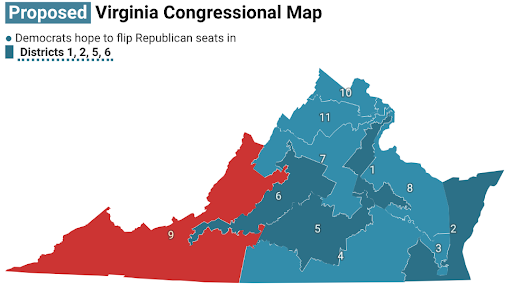
When The Supreme Court of the United States (SCOTUS) dismantled the core of the Voting Rights Act of 1965 (VRA) in late April, the ruling may have felt distant to many Virginians as it was a legal fight playing out in Louisiana, but within two weeks, the fallout hit home.
Louisiana v. Callais struck down the second section of the 1965 civil rights law. For decades, section two allowed civil rights groups to sue states if they drew voting maps that diluted the power of minority voters. The 6-3 conservative majority ruled that creating majority-minority districts to ensure fair representation now counts as an unconstitutional “racial gerrymander.”
In a passionate dissent, Justice Elena Kagan accused her colleges of “hollowing out” the most important civil rights law in American history.
While Louisiana and Alabama grabbed initial headlines, Virginia became the first major test of the post-VRA landscape.
Just weeks before SCOTUS’s ruling, Virginians had passed a constitutional amendment to redraw the state’s congressional map. The plan, backed by democrats, would have created new districts likely giving the party a chance to pick up four additional U.S. House seats in the upcoming midterm elections.
However on May 8, 2026, the Virginia Supreme Court struck down that voter-approved map. The court ruled 4-3 that the Democratic controlled legislature has violated procedural rules when placing the amendment on the ballot.
The court may have felt inclined to respond so aggressively because of SCOTUS’s weakening of the VRA. With the second section gutted, Virginia’s judges faced far fewer federal constraints. The legal shield that once protected minority representation had vanished.
Within hours of Virginia’s ruling, Republican legislators pushed for a new map that would secure their narrow 4-3 majority in the state’s U.S. House delegation.
“This is exactly what critics warned would happen,” said Del. Marcia Price (D-Newport News). “The moment the Supreme Court removed the guardrails, states like Virginia rushed to lock in minority rule.”
Sophia Lin Lakin of the ACLU’s Voting Rights project believes that “Virginia is proving that this isn’t a Southern problem or a Northern problem—it’s an American problem,” and that “when the Supreme Court guts the VRA, the effects ripple into every state within days, not years.”
Activists warn that Virginia is just the beginning. Other states, including Florida, Texas, and Georgia, are now racing to redraw maps that split up minority communities, a practice known as “vote dilution.” Under the new Supreme Court precedent, such maps will be virtually impossible to challenge in federal court.
The Democratic National Committee chair Ken Martin referred to this decision as “a dark day for America,” adding that the GOP-captured Court has “rolled back the clock on the Civil Rights Movement.”
While the ruling is a major setback, the fight is not yet over. Some states, like Minnesota and New York, have passed state-level voting rights acts that still offer protection. Virginia activists are now pushing the General Assembly to pass a state-level VRA as well before the November midterms.