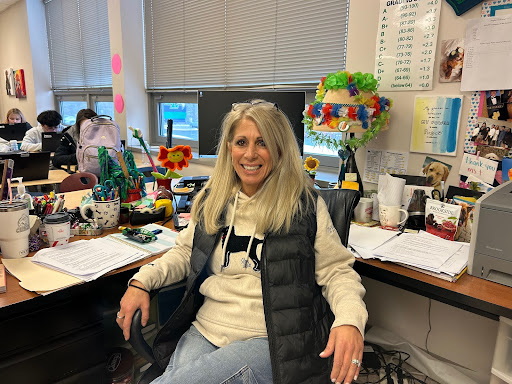
Mrs. Trigiano, affectionately known as Mrs. T, is more than just a journalism teacher; she is a dedicated educator who strives to instill critical thinking in her students and encourages them to question everything they read and see.
Mrs. T was born in Brooklyn, New York, and lived there until her teenage years when her family moved to Virginia. She graduated from Chantilly High School and earned her Communications degree from George Mason University. She is currently the head of the journalism program at South Lakes High School, where she also teaches Honors English 10 and AVID.
Mrs. T’s decision to teach journalism stems from blending two of her core values: compassion for young people and a strong belief in the power of words.
As a result of her own challenging upbringing, Mrs. T understands the difficulties of high school when students are “trying to figure out who [they] are” and dealing with the associated “pressures” of teenage life. This empathy led her to become a teacher to guide the next generation.
Mrs. T believes that “words are very powerful and that there’s a lot for people to know.” She describes herself as a “questioner” who “likes to know why,” emphasizing that “as a free society the number one pressing issue in today’s journalism is a lack of integrity and curiosity and the influence of money and power.
She argues that those in control of modern journalism are often the people in power, rather than the people they are meant to serve. She notes that many outlets prioritize controversy and fear to “garner attention,” instead of “using logic and facts.” A journalist’s role was to be a “watchdog” on the government, not a “lapdog” for whatever political party they happen to support.
This lack of integrity and curiosity dangerously leads to “creating an us vs them mentality,” but most issues are more complex and rarely that black and white, requiring an understanding of all sides to form a well-rounded, independent opinion. She believes that without education and critical thinking, people are susceptible to believing anything without taking the time to form their own opinions.
What she finds most crucial about working with young journalists is keeping them informed, knowing “that they’re going to have an effect” not just in the classroom, but as they transition into their adult lives and careers.
Her most important piece of advice to all students, past and present, is to “think and consider everything [they] read and hear, not just on the internet, but in everyday life. Strive to understand the message being presented and what agenda the source might have. Form your own beliefs and ask yourself, “What do I really believe?”