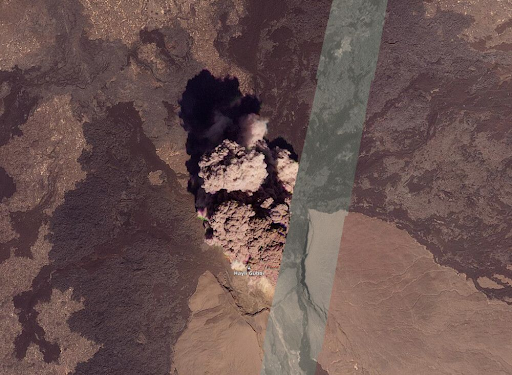
A volcano in the north of Ethiopia erupted Sunday morning. The volcano produced ash clouds nine miles (14km) tall. The volcano, Hayli Gubbi, had no records of eruptions in the past 12,000 years, but records are sparse, considering it is located in one of the most remote and inhospitable regions of the world. The volcano is located in the Afar Rift Volcanic Province, an area experiencing sustained tectonic activity from the movement of plates below the surface of the Earth.
The ash, carried by the wind, left dust drifting across the Red Sea towards Oman, but the dust has now traveled towards India and Pakistan.
In an interview with the Associated Press, local official Mohammed Seid informed reporters that there were no casualties, but that the eruption could impact those who tend to livestock, creating economic disruption.
According to Seid, “while no human lives and livestock have been lost so far, many villages have been covered in ash and as a result their animals have little to eat.”
Volcanoes have indirect health effects on both humans and animals, and because of this Ethiopian local authorities have directed citizens to steer clear of the clouds when at all possible, and to avoid breathing in contaminated air from the eruption. The sulfur dioxide that volcanic eruptions produce can inflame skin and damage the respiratory system.
Furthermore, due to the detrimental effects that volcanic ash has on airplane engines and navigation systems, many flights in and out of the region have been grounded for the time being.
The eruption, despite its human impact, has been an opportunity to study the area and its unique geological situation. Ibrahim Al Jarwan, the Chairman of the Emirates Astronomical Society, considers the eruption a moment with the potential for research. “The event offers a rare opportunity for scientists to study a volcanic system awakening after a very long period of inactivity,” Al Jarwan said, citing the long-term changes occurring in the African Rift, a midpoint in between tectonic plates.
According to the India Meteorological Department (IMD), the ash reached Delhi. This grounded numerous flights and significantly affected the air quality of the city. Using the Air Quality Index, or AQI, Delhi is experiencing an air quality of above 200, and has read above 300, which is considered hazardous to human health.