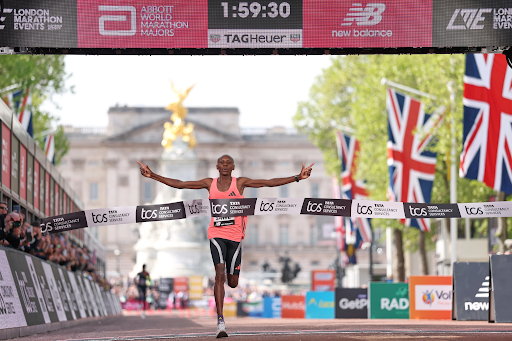
In a historic finish, two men have surpassed the two-hour barrier for the first time in marathon history. Kenyan runner Sabastian Sawe finished in 1 hour, 59 minutes, and 30 seconds, surpassing the men’s world record by over a minute. Ethiopia’s Yomif Kejelcha finished in a time of 1:59.41, despite it being his very first marathon.
Sawe acknowledged that though he broke the record, he did not do it on his own. “What comes today is not for me alone,” Sawe said, “but for all of us today in London.”
History was made in the women’s race, too. Ethiopia’s Tigst Assefa pulled off a 2:15:41, which is considered the world record, but specifically for the women’s only race. Though the women’s record in a mixed marathon stands at 2:09:56 by Ruth Chepng’etich, Assefa successfully defended her own title from the year prior.
Assefa feels very happy with her performance in London, citing the progress she made in practicing for the race. “I screamed when I finished because I knew I was breaking the world record,” Assefa said. “I felt much healthier today and have worked really hard on my speed and all my training has paid off.”
Coming into the race, expectations were high for records to be broken, given the conditions. The 26.2-mile (42.2-kilometer) course is mostly flat, and on April 26th the temperature hovered in the low 60 degree range (15* Celsius), which together make for an optimal running environment.
According to the runners, the fans didn’t hurt either. “I think they help a lot,” Sawe said, “because if it was not for them you don’t feel like you are so loved. You feel so happy and strong, with them calling.”
In recent years, the focus on designing premier shoes for the top level of running has heightened. Adidas is seemingly at the forefront of this change. Tigst Assefa plus four of the men’s top wore Adidas Adizero Adios Pro Evo 3, a prototype designed to be as light as physically possible. Some of the lightest, at a US men’s size 9.5, weigh only 97 grams, which is less than a bar of soap.
The Adidas team has spent years designing them to optimize for even marginal weight reductions in order to get it as lightweight as it is. “At that level, every detail really matters – we were measuring things down to the nearest nanogram,” Patrick Nava, the Adidas Vice President of the running team said.
This remarkable progress has stunned even the runners themselves. In an interview with the WSJ, Nava revealed the runners’ reactions when they saw the shoe for the first time. “When you give them the box, they think it’s a joke,” Nava said. “They think the box is empty.”
Concerns about the possible imbalance generated by this dramatic improvement in running technology have been mounting for quite some time, and regulations have been put in place to limit the amount of material that can be used to cushion a shoe. Trainers as advanced as the Pro Evo 3 also come at a hefty cost for consumers, running at around $500 in USD, raising worries about accessibility for the average runner.
In light of all the controversy, though, the breaking of the 2-hour barrier is an undeniable achievement in running history and a milestone in the improvement of running technology.